

Private 5G is a network customized for specific business sites. Based on ultra-low-latency and highly reliable communications, it serves as dedicated communication infrastructure for enterprises, enabling digital innovation services such as smart factories, AI, and robotics while maximizing productivity and operational efficiency.

5G Technical Features (Private 5G vs. 4G vs. Wi-Fi)
-
01. 4G vs. Private 5G Networks
01. 4G vs. Private 5G Networks Features 4G 5G Expected Benefits Ultra-High Speed
(Maximum Speed)1Gbps 20Gbps Transmits large volumes of data at higher speeds, enabling greater utilization of data-intensive content such as ultra-HD video and MR. Ultra-Low Latency
(Latency Speed)10ms 1ms Applied in sectors requiring immediate responses and reactions, such as remote healthcare and autonomous vehicles, to deliver real-time services with minimal latency. Hyperconnectivity
(Connection Density per km²)100,000 1,000,000 Significantly increases the number of internet-connectable devices and sensors, enabling large-scale IoE and IoT environments. It also serves as a foundational technology for smart homes and smart cities. -
02. Wi-Fi vs. Private 5G Networks
Wi-Fi vs. Private 5G Networks Category Wi-Fi Private 5G Frequency Unlicensed Band Licensed Band Uses the 2.4 GHz, 5 GHz, and 6 GHz bands, resulting in potential interference Uses the 4.72–4.82 GHz (100 MHz) band, without interference Mobility Limited Guaranteed - Limited mobility due to factors such as connection conflicts between APs
- Constraints on the number of connected devices and wireless resource capacity expansion
- Guaranteed mobility between cells or base stations
- Multi-cell architecture enables unrestricted wireless resource capacity expansion
Service Scale Home and public facilities Private wireless networks for enterprises and organizations
Private 5G Network Deployment Models
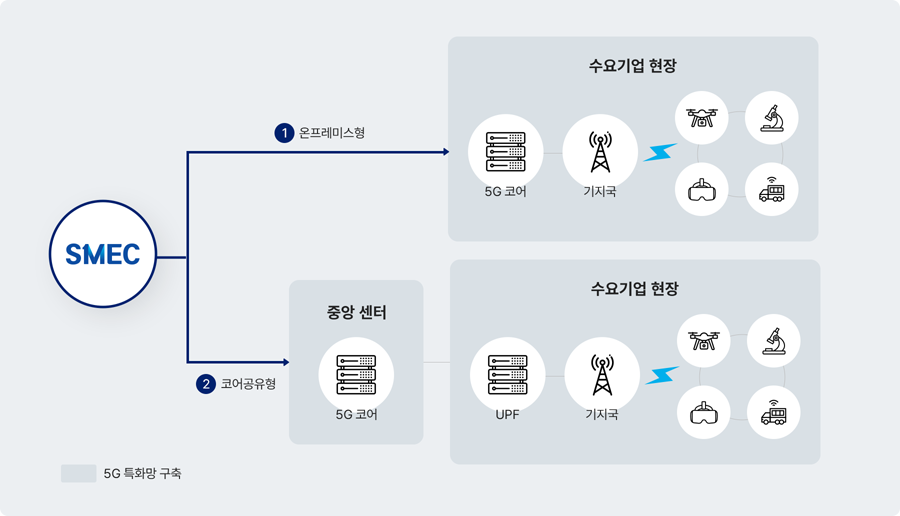
- 1) On-premises: A model in which all private 5G equipment, including radio base stations and 5G cores, is deployed on-site at the enterprise facility for exclusive use by the client.
- 2) Shared core: A model that deploys only radio base stations and UPF on-site at the enterprise facility, with a central 5G core shared among multiple clients
Key Features & Advantages of SMEC Services
01
Dedicated support for administrative procedures related to spectrum allocation and acquisition
02
Private 5G network operations by technical experts
03
24/7/365 monitoring
04
Reduced initial investment through various pricing plans
Service Delivery Process
-
 01Needs
analysis -
 02On-site
inspection -
 03Wireless
network design -
 04Quotation
negotiation -
 05Service
contract -
 06Network
setup -
 07Service
delivery
Key Deployment Cases
-
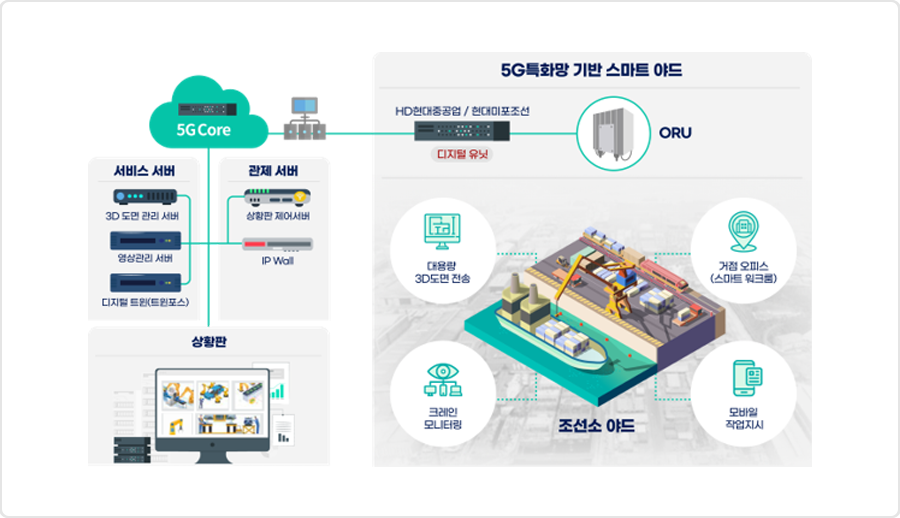
- Integrating crane-mounted special cameras with private 5G; enhancing 3D drawing transmission and work instruction services across the shipyard; deploying a 5G network and device monitoring system
01. HD Hyundai Heavy Industries & HD Hyundai Mipo Dockyard (2023)
-
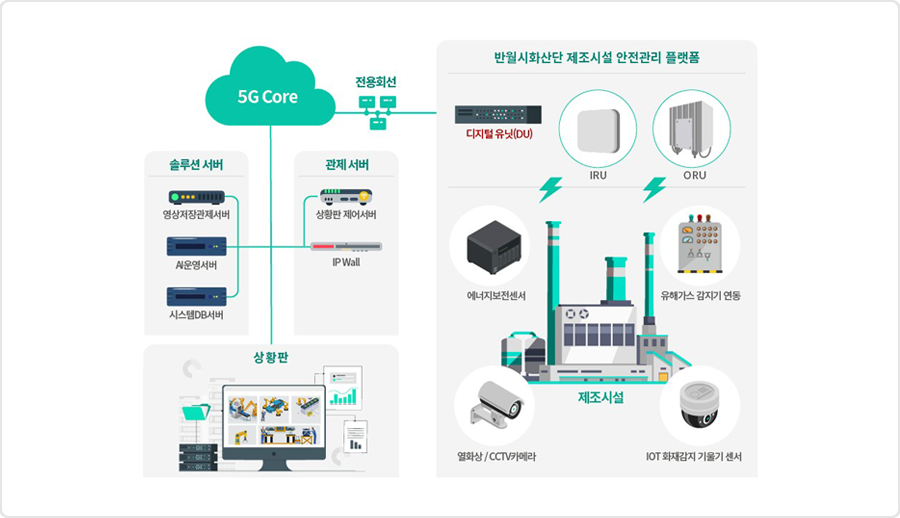
- Providing six industrial safety and disaster solutions: hazardous behavior control, mobile equipment accident prevention, electrical accident prevention, poisoning and asphyxiation accident prevention, fire and firefighting alerts, and smart safety management system deployment
02. TLB (2022)
-
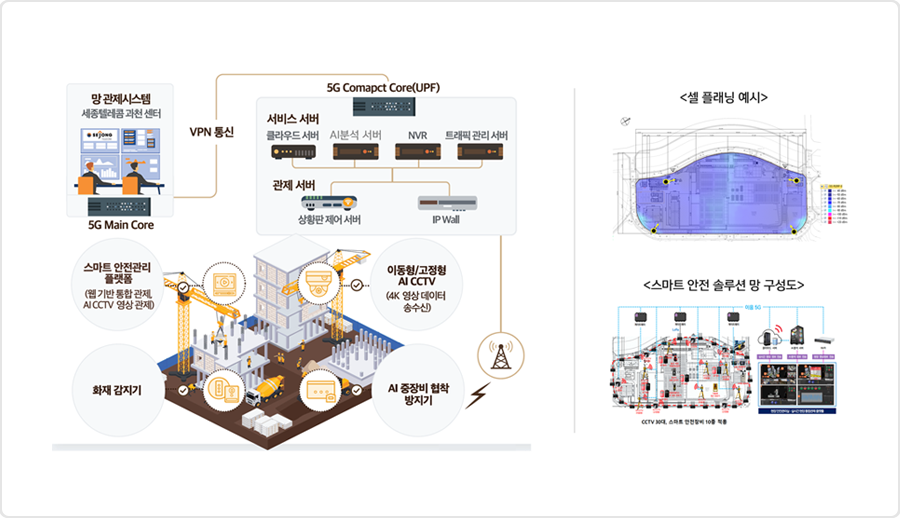
- Implementing disaster safety solutions for construction sites, including a smart safety management platform, mobile and fixed AI CCTV systems, an AI-powered heavy equipment anti-pinch system, and on-site fire detectors
03. Kolon Global's Merck Plant Construction Site in Daejeon (2024)